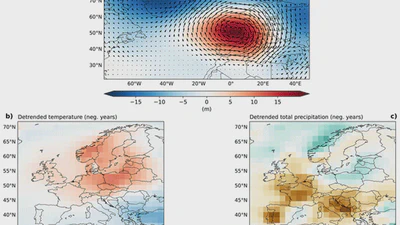
Northern Greenland transect stacked ice cores as a proxy for winter extreme events in Europe

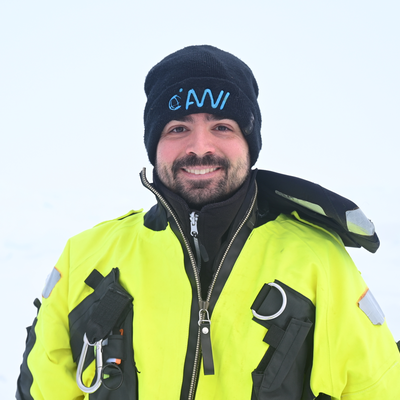
(he/him)
PhD candidate in Paleoclimate Dynamics
Alfred Wegener Institute, Helmholtz Centre for Polar and Marine Research
I am a PhD candidate in Physics (Paleoclimate Dynamics) at the Alfred Wegener Institute and the University of Bremen. I use Greenland ice cores to study atmospheric rivers, blocking and extreme weather over Europe. I have also joined two research expeditions to the Arctic Ocean, both of which reached the North Pole.
I came to climate science from statistics, with a PhD in Statistical Sciences from the University of Padua. I then decided to do a second PhD, not just to train as a climate scientist, but also because I feel a deep rooted sense of belonging to this field.
I am fascinated by warm and moist air intrusions and extreme events in the polar regions, especially atmospheric rivers, and I am eager to keep learning and grow into an expert in this field.
PhD in Statistical Sciences
University of Padua, Italy
Master's Degree in Computer Science
Ca' Foscari University of Venice, Italy
Bachelor's Degree in Statistics and Computer Science for Business Management
Ca' Foscari University of Venice, Italy
My PhD asks what Greenland ice cores can tell us about the weather systems that carry heat and moisture into the Arctic and bring extreme weather to Europe. In my first paper, I showed that ice cores from a transect across northern Greenland record winter extreme events in Europe (Climate of the Past, 2026). I am now studying how atmospheric rivers leave their mark on the oxygen isotopes stored in the ice, and how changes in large-scale circulation are reshaping atmospheric river activity in northern Europe.
I have also contributed to research on past Arctic sea ice, as a co-author of two studies that use bromine enrichment in ice cores to reconstruct it: one on sea ice changes in Baffin Bay and the Labrador Sea during the abrupt climate changes of the last glacial period (Proceedings of the National Academy of Sciences, 2022), and one that calibrates Arctic ice core bromine records against satellite sea ice observations, to make these reconstructions more reliable (Science of The Total Environment, 2024).
In addition, I have worked on marine heatwaves, as a co-author of two studies: one on the record-breaking marine heatwaves of 2023–2024 (Bulletin of the American Meteorological Society, 2025), and one on the biogeochemical impacts of the 2019 marine heatwave in the Northeast Pacific (Geophysical Research Letters, 2025).
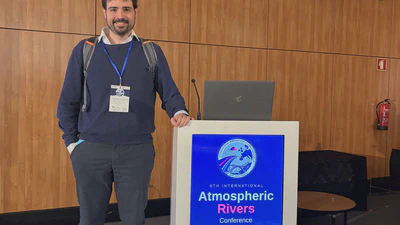
Talk
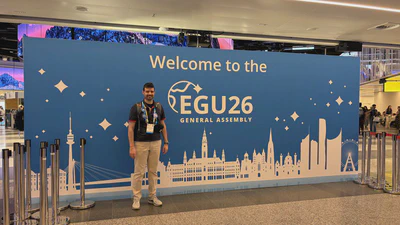
Poster
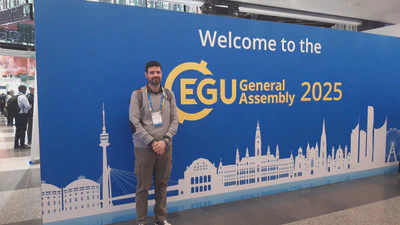
Poster
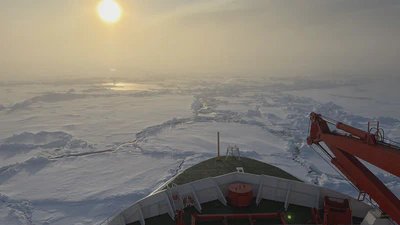
70 days at sea from Tromsø via Greenland and the Lomonosov Ridge to Bremerhaven, as seismic deck operator and watch keeper.
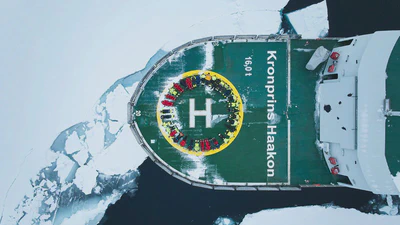
35 days at sea from Longyearbyen to the Lomonosov Ridge and the North Pole, collecting water samples and handling marine sediments.
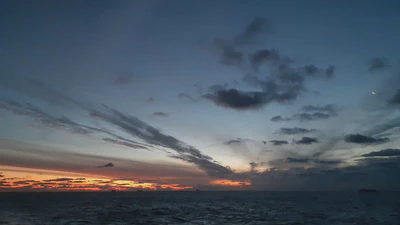
12 days at sea from Bremerhaven to the Canary Islands, training in echosounding, sub-bottom profiling and bathymetry.
3 days at sea from Bremerhaven to Helgoland in the North Sea, running and processing CTD, SVP and ADCP measurements.