Northern Greenland transect stacked ice cores as a proxy for winter extreme events in Europe
gen 1, 2026·
 ,
,
,
·
0 min di lettura
Alessandro Gagliardi
N. Rimbu
G. Lohmann
M. Ionita
Abstract
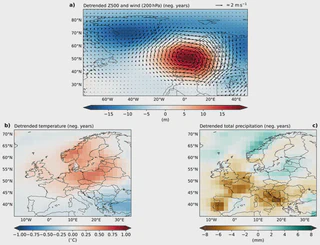
High-resolution ice core records from the Greenland ice sheet provide critical insights into past climate variability across seasonal to multidecadal timescales. A key proxy in these reconstructions is the concentration of stable oxygen isotopes (δ¹⁸O), which reflects both regional climatic conditions, such as temperature, as well as atmospheric and oceanic circulation patterns. While some studies have linked δ¹⁸O variability to synoptic-scale phenomena, particularly atmospheric blocking, its relationship to extreme hydroclimatic events in Europe remains underexplored. This study demonstrates that a stacked record of δ¹⁸O from the Northern Greenland Transect (NGT), spanning 1602–2011, serves as a proxy for hydroclimatic extremes in Europe. The connection between δ¹⁸O anomalies and European atmospheric circulation patterns is investigated across two periods: the observational era (1920–2011) and a longer historical context (1602–2003) using paleoclimate reanalysis data. Composite analysis reveals that years characterized by low δ¹⁸O values in the NGT record correspond to an increased frequency of atmospheric blocking over Europe. These blocking events are associated with distinct hydroclimatic extremes. Specifically, the analysis shows a consistent pattern of enhanced frequency of extreme precipitation along Norwegian coast and more frequent extreme drier conditions over southern Europe during such years. The persistence of this linkage in both modern observations and long-term reconstructions underscores the robustness and temporal stability of the relationship between Greenland δ¹⁸O variability and European hydroclimatic extremes driven by atmospheric blocking.
Tipo
Publicazione
Climate of the Past, 22(5), 935–955
